
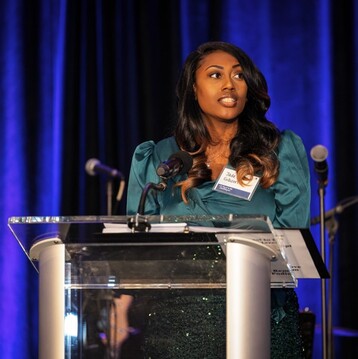
By Jade Gibson, Pediatric ovarian cancer survivor and patient advocat
At 15, Jade Gibson was diagnosed with a rare germ-cell ovarian cancer. In the 19 years since her doctor at her hometown hospital in Georgia walked her through her treatment plan, Jade has been advocating for improved services for adolescent and young adult cancer patients in rural communities. Today, she also serves as a patient advocate for the Children’s Oncology Group.
ALL PHOTOS COURTESY OF JADE GIBSON
The anticipation of summer break for high school students can be filled with excitement. Most teenagers are looking forward to family vacations, participation in academic or sports programs, part-time jobs, and most importantly – no homework!
But in the summer of 2005, I did none of those things. Instead, I spent the months between my sophomore and junior years of high school having two invasive abdominal surgeries, that involved removing one ovary and one fallopian tube. That was followed by eight rounds of three different types of chemotherapy to treat a rare ovarian germ cell tumor the size of a grapefruit.
Thanks to the wonderful care team in pediatric oncology at the Medical Center of Central Georgia Children’s Hospital, I’ve been cancer-free for 19 years. Survivorship has taught me that cancer is a disease that attacks more than just your physical well-being, it affects every single part of your life.
My hometown of Macon, Georgia is in a rural part of the state. At the time, my hospital lacked many of the support services that larger hospitals in bigger cities often have. To improve my overall health, I’ve learned a lot by advocating for my unique needs. In advocating for myself, I found my professional calling as a patient navigator.
Symptoms that led to rumors and judgment
I was 15 when my mother noticed my menstrual cycles were only occurring every other month. Concerned, she scheduled my first appointment with a gynecologist. During the appointment, the doctor did an ultrasound and told us he saw a tiny mass that he thought was a cyst. He wasn’t overly concerned but wanted me to come back in a few months.
However, before that follow-up appointment, I began having severe abdominal pain and nausea. I also started vomiting – a lot. And I was tired all the time. The most alarming part of my physical symptoms happened when my stomach began to protrude. This didn’t fare well for someone who experienced bullying in primary school.
In high school, I was a reserved and studious student. Though I was not very sociable, I remember the stares and unwanted attention when rumors began to swirl that I might be pregnant.
When the results came in they were clear – I had Stage III ovarian cancer. Most people don’t think about ovarian cancer happening in kids, but it can happen to babies, toddlers, and teenagers like me.
Beginning my lifesaving treatment
Because the path to diagnosis was a bit uncoordinated, my mother decided to get a second opinion at Children’s Hospital of Atlanta – a two-hour drive from Macon. In the end, she decided to pursue treatment closer to home.
At the Medical Center of Central Georgia, we met with, now retired, Gary Eddy, M.D., an expert in gynecological cancers, who would perform the surgery. As Dr. Eddy walked us through the procedure, I realized he was the first physician to include me in the conversation about the steps that would be taken to save my life.
After surgery, I went home to recover and build up some strength before my chemotherapy treatment began. While I felt prepared for all the medical scenarios, I wasn’t prepared for the emotional toll surgery takes – or the sudden absence of my independence. Recovery was difficult and I needed help from everyone for every little thing.
A few weeks later, I started chemotherapy. As expected, I lost my hair and I lost weight. My nails were fragile and some discolored. I was told I had “thin skin” which caused me to bruise more easily. My time was spent alternating between weeks of in-patient hospital stays, going home to give my body rest, and completing my studies for junior year.
I’m so thankful to my oncologist Ihsan Al-Khalil, M.D., who is now retired, my nurses and my technicians. They did their best to make each admission feel like we were at our home away from home. After having spent the entire month of October in the hospital, they knew how badly I wanted to spend Thanksgiving at home, with my family, and they made it happen.
Many teenage oncology patients want to complete treatment quickly and get back to the life they knew before cancer. But cancer happened in the midst of me developing into a young woman. Whoever she was, whatever dreams she carried, I would never know. So much had happened without me realizing all of the physical and emotional scars that remained, long after treatment was over. When I returned to school for senior year, it felt like there was an expectation for life to go back to “normal”.
When I was 18, Dr. Al-Khalil cleared me to be in “surveillance” – it’s the phase between active treatment and “survivorship”. Being in surveillance meant I didn’t have to take nearly as many medications or make as many trips to the hospital for labs or imaging.
My excitement turned into devastation when I was repeatedly told that I was ineligible because I was no longer in active treatment. I was also now 18 or I didn’t meet certain criteria.
In the 19 years since my diagnosis, I’ve grown physically, mentally and emotionally stronger. In addition to being a professional patient advocate, this is also where I spend my volunteer time. I’m especially focused on advocating for adolescent young adult (AYA) cancer survivorship.
In 2019, I began volunteering with the Georgia Center for Oncology Research and Education. This organization specifically focuses on strengthening cancer care for patients in our state.
Why do I spend so much of my time being a voice for current and future cancer patients? Because every cancer patient needs quality cognitive and emotional care – in addition to expert physical care. The psychological challenges that many of us live with during and after treatment are complex. When we visit a hospital or clinic, certain sounds or smells can instantly trigger the wounds that live within us. The anxiety, or as we patients call it “scanxiety,” that comes with waiting for imaging results is overwhelming.
The American Childhood Cancer Organization says, “Clinical research has been responsible for the discovery of many groundbreaking treatments for childhood cancers.” Yet, all of us in the pediatric cancer community are well aware that 4% of federal funding goes toward researching childhood cancers. This simply is not enough.
Much of the progress that has been made, is thanks to gifts of $5 and $5 million and everything in between to places like the Children’s Oncology Group Foundation. Without philanthropic investment in childhood cancer research, dozens of nonprofits, foundations, and thousands of families would not be supported in the crusade for discoveries. As an emerging research advocate, I’m learning the power of the patient voice and it motivates me to share my story and this mission.