
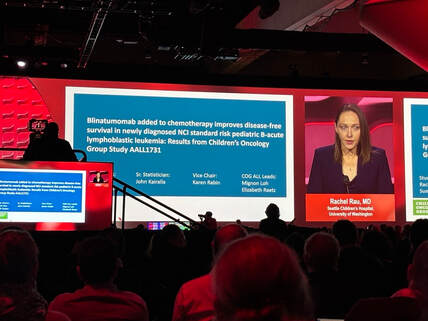
Cheers and tears spread across the Children’s Oncology Group (COG) network. Finally, after decades of research, many kids diagnosed with B-cell acute lymphoblastic leukemia (ALL), have a new treatment available to them – one that is highly effective and has more manageable side effects.
A shockwave of joy. That’s how pediatric oncologists Rachel Rau, MD opens in a new tab, from Seattle Children’s, and Sumit Gupta, MD, PhD opens in a new tab, from SickKids in Toronto, describe the weeks following news that the clinical trial they were leading would be closed two years early thanks to its unprecedented success.
The COG researchers hoped that adding an immunotherapy called blinatumomab to the standard treatment plan for B-ALL patients would lower relapse rates. The answer was a resounding and early yes.
“I’m still trying to wrap my head around being part of something that literally changed the way we treat the most common childhood cancer,” Dr. Rau says.
The decision to close the trial early came from the independent committee that monitored the trial’s progress. After reviewing the study’s initial results, the outcomes were clear: adding blinatumomab to treatment substantially reduced relapse rates.
Dr. Rau and Dr. Gupta heard the news from David Teachey, MD opens in a new tab, with Children’s Hospital of Philadelphia (CHOP), who chairs the ALL committee for COG. He was just as overwhelmed with the monumental results as they were and told them that in addition to closing the trial early, the review committee also recommended blinatumomab become part of standard treatment plans for the majority of B-ALL patients – even those currently being treated who had not been part of the trial.
As Dr. Gupta began working with his SickKids colleagues to update their patients’ care plans, he realized pediatric oncology teams all over the U.S., Canada, Australia, and New Zealand were doing the same thing.
“I had a moment when I realized physicians at every COG site would be explaining to families that there was now a better drug – and how that would give families additional hope and relief,” Dr. Gupta says.
The first task was sharing news of the trial’s results with the 220 COG member hospitals opens in a new tab – and informing them about the upcoming changes to treatment plans. COG sites were committed to overcoming the major financial and logistical challenges involved in getting blinatumomab and giving it to their patients.
“The effort it took to get this therapy to thousands of kids is a wonderful testament to how dedicated the pediatric cancer community is, and COG is what has allowed us to create the culture of collaboration,” Dr. Rau says.
Blinatumomab works by attaching itself to the CD19 protein, which is present on the surface of virtually all cancerous B-ALL cells. The drug also directs the body’s immune-fighting T cells to seek out CD19 positive B-ALL cells. When the cancer cells and the immune cells get close enough, the T cells attack and destroy the cancer.
“Now, when a child is diagnosed with B-ALL, their treatment plan will include two month-long treatments of blinatumomab between blocks of their standard chemotherapy treatments,” Dr. Rau says.
Having a targeted immunotherapy as part of the standard treatment plan is a victory for B-cell ALL patients, which make up about 85% of all ALL diagnoses.
“Chemotherapies are great at destroying fast-growing cells, but they don’t know the difference between good, healthy, fast-growing cells and fast-growing cancer cells,” Dr. Gupta says. “When I talk to families, I explain that immunotherapies are much smarter versions of chemotherapies because they generally leave most of the healthy cells alone and focus on destroying the cancer cells.”
“Now, we need to study why some patients who receive blinatumomab have more severe side effects than others. We need to understand why there’s still a small group of patients who relapse, even with this therapy,” Dr. Rau says. “Another exciting question is, can blinatumomab replace some parts of traditional chemotherapy rather than just be used in addition to chemotherapy?”
In addition to being grateful to the thousands of people across all 220 COG centers who helped make the study possible, the physicians have specific sentiments for patient families.
The other champions for research, they note, are the patients and families themselves – their dedication as advocates and fundraisers and their hope for all cancer patients has never been greater.
A big thank you to the St. Baldrick’s Foundation opens in a new tab and the Jeffrey Pride Foundation opens in a new tab for your support of AALL1731!