
This is the first in a series of articles about how COG clinical trials come to be.
Future newsletters will delve into how the concept of a clinical trial becomes a protocol, different types of clinical trials, and more.
Children’s Oncology Group (COG) researchers are constantly coming up with new ideas to study cancer in children. But how exactly do those ideas evolve into clinical trials that break new ground in treating kids with cancer? The answer: a rigorous process of considering research ideas from every possible angle, so that only the very best ideas move forward.
Pediatric cancer treatments have come a long way in recent decades. But doctors who treat pediatric cancer are keenly aware of the limits and drawbacks of today’s treatments. So they’re constantly looking for ways to make current treatments better and develop new, more effective treatments with fewer side effects, so that more kids can live long, healthy lives.
Dr. Dome led the COG Renal Tumor Committee and now serves as a member of the COG Scientific Council, made up of senior COG leaders who have extensive research experience and review every idea that becomes a COG clinical trial.
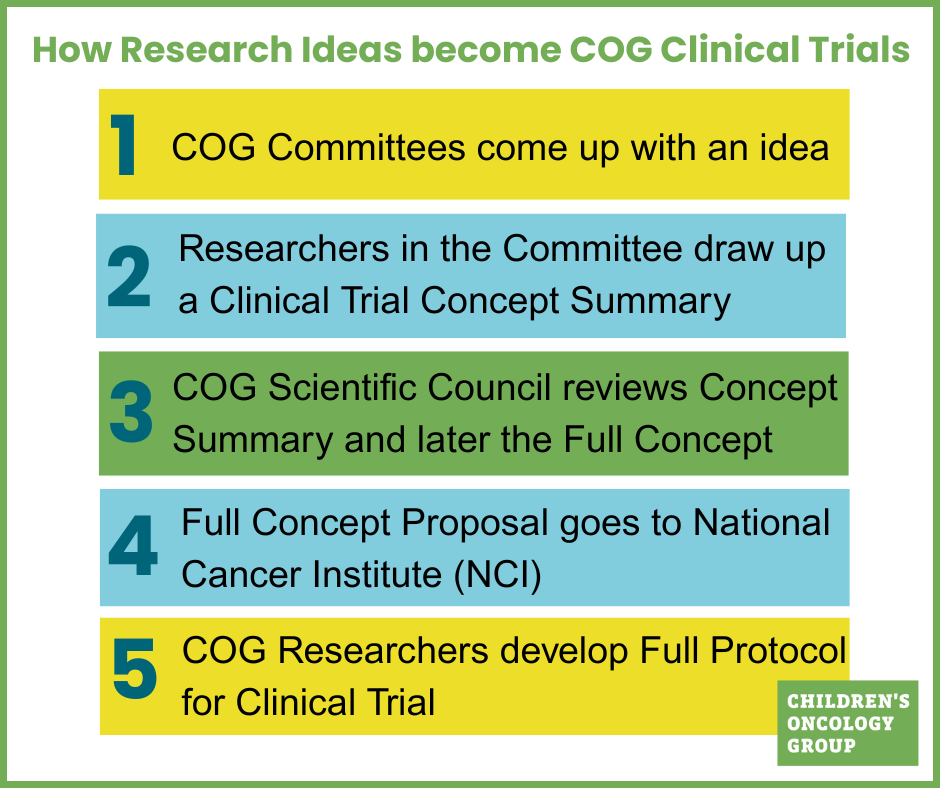
It can take months to years of painstaking vetting before a research idea is ready to be formally presented to the Scientific Council for review and approval. Three types of COG committees generate ideas and gather data to bolster research concepts during this first phase of the process:
- Disease committeesare multidisciplinary teams that focus on a specific type of cancer opens in a new tab, with representation from multiple disciplines (i.e., surgeons, medical oncologists, radiologists, nurses, statisticians, and others).
- Domain committees have thematic areas of focus that encompass different disease types. Examples include epidemiology, stem cell transplant, and developmental therapeutics (i.e., studying new drugs to treat cancer).
- Discipline committeesrepresent a single type of medical professional (i.e., pathologists, radiologists, epidemiologists, patient advocates, and others).
These committees typically meet once a month and review research ideas at each meeting. In some cases, they’re reviewing an idea for the first time. Other times, they’re revisiting an idea after multiple rounds of feedback.
Once a committee reaches consensus that an idea is strong enough to move forward, it’s time to draw up a concise, high-level overview called a clinical trial concept summary to gauge initial interest in their idea and how feasible it might be.
This step pulls together all the key considerations committee members have discussed in their meetings — the research question, target population, the treatment or procedure that will be tested, and expected outcomes.
Once a concept summary gets a thumbs-up at the committee level, it goes to the COG Scientific Council.
Senior leaders on the COG Scientific Council bring decades of experience running clinical trials to their analysis of research ideas. They meet twice a month, asking critical questions about every aspect of each concept they consider:
- Is there sufficiently compelling background to support the primary objectives of the study?
- Are the primary objectives and theories about potential outcomes on point and clearly stated?
- Are the secondary aims (e.g., addressing potential side effects or differing effects in subgroups) justified?
- Are the criteria for including or excluding patients appropriate?
- Have researchers ruled out any significant feasibility issues, such as competing studies on the same population?
There are often several iterations of a concept summary that go between the committees and Scientific Council on its way to becoming a full concept proposal outlining the concept in greater detail. The Scientific Council is the final set of eyes that reviews a trial concept before it gets pitched outside of COG’s walls.
The National Cancer Institute (NCI) opens in a new tab, part of the National Institutes of Health (NIH), is the largest funder of cancer research in the world. Leading experts in their fields serve on NCI Scientific Steering Committees opens in a new tab, which focus on specific types of cancer and domains of research — gauging the strength of research concepts just like the COG Scientific Council does.
A clock starts ticking with this step, and researchers have up to a year and a half (400 to 540 days, to be precise) to clear the final approval hurdle and open a clinical trial. From this point on, there’s lots of back-and-forth communication between the NCI and COG. Once the NCI approves the full concept proposal, it’s time to develop the full protocol for a clinical trial.
Clinical trial protocols are the all-encompassing road maps that outline research goals, which patients are eligible, methodologies for tests and treatments, safety considerations, data management plans, a timeline — everything about how a trial will be conducted.
Once the NCI OK’s a full protocol, it advances to the finish line of a research idea’s marathon concept to actual clinical trial. The NCI’s Central Institutional Review Board (CIRB) opens in a new tab combs through every aspect of the protocol to make sure the trial will meet the highest ethical standards.
After the CIRB approves a protocol and the case report forms are complete, the study is ready for activation. At each hospital or research center participating in the trial, institutional principal investigators then decide whether to activate the studies at their own sites.
About a dozen ideas for COG clinical trials go through this process each year. Most become clinical trials, Dr. Dome said, noting that in many cases, “we start anticipating the next study before the current study opens. We’re always thinking ahead.”
How Philanthropy Gives Research Ideas Lift-off
It often takes one or two years, sometimes more, for a research idea to clear all the review hurdles to be approved as an actual clinical trial. It’s an exhaustive process that requires a huge investment of time and effort, and it’s often not funded.
“Lack of funding is the single biggest contributor to trials not moving forward,” said Michael V. Ortiz, MD opens in a new tab, a pediatric hematologist-oncologist at Memorial Sloan Kettering Cancer Center.
“Often, for a given project, you have several grant applications in place, and you can’t move anything forward until you have enough funds to fully support the trial.”
This is why generous support from individual and foundation donors plays such a vital role in making COG research happen. Some private funders are heeding the call to support researchers as they do the early legwork to develop promising research ideas into clinical trials.
“We want to fund smart initiatives that wouldn’t have happened if we hadn’t stepped in, or at the very least, accelerate the progress of great projects that need more funding,” said Joe McDonough, president of The Andrew McDonough B+ Foundation opens in a new tab.
The B+ Foundation also understands the importance of giving young researchers opportunities to gain valuable experience running trials from start to finish.
“Our children need to be able to rely on this pipeline of brilliant, young doctors,” said Joe, who created The B+ Foundation after his son, Andrew, died of leukemia at age 14.
Advancing the next generation of clinical trial leaders
The B+ Foundation funds COG’s Dr. Peter Adamson Young Researcher Award to support both early-stage research and up-and-coming clinical trial investigators like Dr. Ortiz, who studies rare and high-risk solid tumors in children.
“When we study treatments for the rarest of pediatric tumors, it’s challenging to galvanize both interest and funding support,” Dr. Ortiz says. “We also have to run the trials in multiple sites, which makes them costly. Donor funding is essential to launch these trials and keep them moving forward.”
Award funding can also help young researchers closer to the finish line of a clinical trial. That was the case for Jennifer Foster, MD, MPH opens in a new tab, a neuroblastoma specialist at Texas Children’s Cancer Center, who used funding from her Peter Adamson Young Researcher Award to finish and analyze the results of a COG clinical trial of a promising new treatment for children with difficult-to-cure brain tumors and solid tumors.
Dr. Foster has also used award funding to mentor junior researchers. With support from the Robert A. Winn Excellence in Clinical Trials: Clinical Investigator Leadership Award Powered by Conquer Cancer’s EveryGrant opens in a new tab, Dr. Foster is mentoring Fiorella Iglesias Cardenas, MD, MS opens in a new tab, a pediatric oncologist at Memorial Sloan Kettering developing clinical trials for new therapies to treat high-risk neuroblastoma.
“As clinical trial investigators, we are constantly learning from the experience of our colleagues,” Dr. Foster said. “Learning about Dr. Iglesias’s exciting clinical trial ideas and working to incorporate them into our trial design has helped hone my experience as a clinical trial investigator as well.”
Awards like these often help young researchers secure additional sources of funding, allowing them to dedicate more time to their research, uninterrupted by clinical, teaching, or administrative duties.
“Funding usually begets more funding,” said Dr. Foster, a recent recipient of a coveted a National Cancer Institute (NCI) Research Specialist Award (R50) opens in a new tab. “I’m not sure if donors, and potential donors, are fully aware of all the positive downstream impacts of their generosity.”